
Spring is an ideal time to sow many seeds. In fact, the progressive lengthening of daylight day duration and rising temperatures are factors that will favor germination of some plants.
We can sow annuals, biennials or perennials.
What precautions should be taken for annuals or frost-sensitive plants?
Annuals
Annuals complete their cycle in a year (article on annuals / perennials), it is advisable to sow them early in the year. For annuals, the sowing period runs from late February to May 15th. If several harvests are desired, we can spread out the sowing over this period.
Frost-sensitive plants
For some plants, the main danger at springtime is the possibility of negative temperatures.
Here at the nursery, a number of seeds are protected by a winter veil until May 15. Some plants that cannot tolerate frost, such as blessed thistle, sulphur cosmos, red cosmos, large capuchin, black jasmine, blue ipomoea, …
In the vegetable garden, we will also think about tomatoes, cucumbers, zucchini, and squash…
The "Graine de vie" nursery is located in a mountainous area in the Central Massif. It is common to have frosts until the period known as the Ice Saints (approximately around May 12). Some years, the risk of frost can last until early June.
Particular case of hardy plants
On the other hand, some plants are indifferent to cold and will even prefer temperatures that are not necessarily negative but cool (between 0°C and 10°C). Among these hardy plants, we find bergamot and angelica.
Not all seeds require a temperature of 25°C!
What sowing to choose: sowing in pots or direct sowing?
Sowing in trays
Sowing in trays is particularly interesting in several cases: production of seedlings, protection from pests and diseases, sowing plants requiring heat, etc.
You can use any container (plastic pots, polystyrene tubs, etc.), preferably flat.
Fill it 3/4 of the way with the best draining potting soil possible. At the Graine de vie” nursery, we use our fingers to sow. It important for us to be in contact with the seed.
Sowing involves spreading the seeds over the surface. For some tiny seeds, you really need to have a light hand, because you have to not to get in the way when transplanting!
You'll also need to keep your sowing hand clean. It's not at all practical to have a hand full of soil and sow at the same time.
Depending on the size of the seed, cover it more or less, as some seeds need light to germinate. Then tamp lightly with the flat of your hand.

To put it simply, the smaller the seed, the more you sow on the surface.
Don't forget to water. Seeds can't germinate without water!
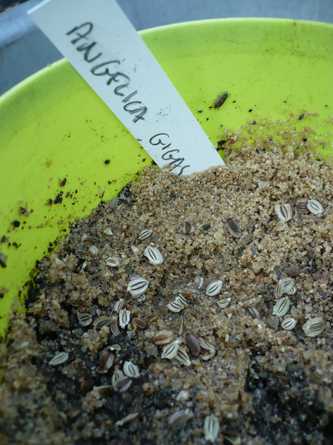
Don't forget to label your trays!
Seedlings in trays are often placed in greenhouses.
In spring, we come to see our seedlings every day. The beginning of life is, of course, extremely fragile and vulnerable. It’s neccesary to have a look at diseases, such as damping-off, water requirements or the risk of frost.
Damping off is favored by high humidity and temperature. Too much water is just as damaging as too little.
Direct sowing
Direct sowing in the open ground is suitable for plants that do not need to be sown under cover (coriander, parsley) or cannot be transplanted (poppies, white mustard).
The hook and the rake are often necessary afterwards to remove unwanted weeds and make the earth lighter.
These operations should be done when the ground is not too wet.
We will dig a furrow, more or less deep, depending on the size of the seed we have to sow. You don't enter a bean seed like a coriander or poppy seed. We delicately distribute the seeds in the furrow.
The furrow is then covered, plumbed (packed with the back of a rake) then watered. A seed cannot germinate without water!
The idea is that more seeds are needed for sowing in the ground, and less work. On the other hand, it will be necessary to thin out and we can take advantage of it to transplant these small plants. Be careful, sowing in open ground is always more uncertain than sowing in a pot.
How long should I wait after sowing?
Seeds of medicinal plants, often wild, do not germinate in 4 days like radishes. It is necessary to be patient. Some seeds can take several months to germinate. We have already seen a spring sowing of marigold germinate the following year.
We often find ourselves waiting more than a year before throwing away a pot of seedlings, during which time we continue to water and observe what happens.
It's not because a seed has fallen to the ground or been sown that it will automatically germinate.
Conclusion
Spring is a period tinged with magic, where everything comes back to life, as if all had been extinguished and dead. An immutable and mysterious principle is at work, making it so that every spring, leaves appear on trees and many seeds germinate.
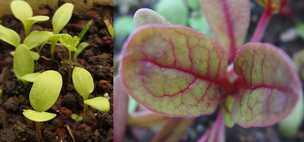
Spring can be considered the best sowing period for many plants.
After this article on spring sowing, retrieve the article about automn sowing.
Share your experience or ask a question.
Add your comment